
Nelson Switzer: Gigacorn Hunter
Program Titles
- THIS IS THE CLIMATE ECONOMY: The repeatable pattern behind ventures that remove a billion tons of carbon while reaching billion-dollar valuations. What if the biggest climate story isn’t about climate at all, but about the wholesale reinvention of the global economy? In his signature keynote, investor and The Gigacorn Hunter author Nelson Switzer reframes decarbonization as one of the largest capital-allocation and industrial transformations in history. Energy, transportation, food, buildings, manufacturing, and waste are all being rebuilt at once – creating extraordinary opportunities for the companies and investors able to recognize where economic value and carbon reduction reinforce one another. Drawing on more than two decades inside corporations, markets and climate-tech investing, Switzer reveals the repeatable pattern behind the companies he calls Gigacorns: businesses capable of removing or avoiding a billion tonnes of carbon while building billion-dollar enterprise value. Provocative, optimistic and grounded in real-world economics, This Is the Climate Economy gives audiences a new lens on the transition, not as an environmental obligation, but as a once-in-a-generation opportunity to create growth, resilience, prosperity and competitive advantage.
- WHY INTUITION WON’T SAVE THE CLIMATE: Data is the key to successful climate technology investing. The more complex the decision, the more dangerous it becomes to trust the feeling that the answer is “obvious.” In this highly engaging keynote, adapted from his TEDx talk, Nelson Switzer demonstrates just how easily experience, emotion and incomplete information can fool even sophisticated decision-makers. From a deceptively simple optical illusion to counterintuitive investment choices, he exposes the cognitive biases and information gaps that allow confidence to masquerade as insight and explains why instinct alone becomes less reliable as uncertainty rises. Switzer then shows audiences how to rebuild intuition on evidence. Drawing from the analytical discipline he uses to evaluate climate technologies, he introduces a deceptively simple habit: before accepting the story, quantify what matters. How much? How fast? At what cost? The result is not an argument against intuition, but a blueprint for making it better – giving investors, executives and leaders a practical way to challenge assumptions, recognize decision-making traps and make more confident choices when the data is imperfect and the stakes are high.
- The four assumptions climate investors get wrong, and how to fix them. Some of the most expensive mistakes in investing begin with two words: “It’s obvious.” In Questioning the Obvious, Nelson Switzer takes aim at four assumptions shaping billions of dollars of climate investment: that a great technology is automatically a “no-brainer”; that political disruption inevitably destroys an opportunity; that AI will necessarily accelerate decarbonization; and that one tonnes of carbon is economically equivalent to another. Using real companies, market failures and unexpected data, he shows how seemingly sensible assumptions can stretch timelines, destroy valuations and trap capital. What emerges is a sharper way to invest and lead under uncertainty. Switzer shows why adoption depends on the logic of the critical stakeholder, not the investor; why policy can delay a mature technology without killing it; why AI’s climate impact depends on where capital and compute are directed; and why the most valuable carbon reductions are often those embedded inside businesses that create their own economic pull. The takeaway is both simple and powerful: better investors don’t predict the future by accepting what everyone knows. They outperform by questioning what everyone assumes.
- THE RULE OF 44: A single test that separates a category-leading climate deal from one destined to stay a pilot For a decade, the Rule of 40 gave software investors a shorthand for identifying exceptional companies. Climate tech needs a rule of its own. Nelson Switzer introduces The Rule of 44, a provocative new test for separating climate technologies capable of becoming category leaders from those likely to remain trapped in pilots. The equation combines two forces that ultimately determine adoption: the economic improvement a technology creates for its customer and the durable carbon value that customer can actually capture. Together, they must reach 44 – the molecular weight of CO2 and, Switzer argues, the new benchmark for underwriting the physical economy. Through striking real-world contrasts – from technologies that sail through the test to heavily subsidized solutions that still fail it – Switzer shows why climate benefit, policy support and technological brilliance are not enough to guarantee adoption. For founders, the Rule of 44 exposes what must change for customers to buy. For investors, it provides a disciplined screen for finding fund-returning companies. And for LPs, it offers a remarkably simple way to distinguish rigorous climate investing from compelling climate storytelling. Audiences leave with a framework they can immediately apply to the companies, portfolios, and investment managers in front of them.
Nelson Switzer built his career on fixing the economy’s deepest inefficiencies. He leads a venture fund that backs companies that can reach billion-dollar valuations while removing a billion tons of carbon from the economy. One of the best leadership voices in the world on sustainability, climate, and water. Authentic, informed, and inspiring—exactly what’s needed in this space. Your audience will be moved, challenged, and energized. A truly world-class speaker. – Chief Catalyst & Community Builder Worldwide.
He served as Chief Sustainability Officer at Nestlé, held senior roles at PwC, Centrica, and RBC, and advised more than 150 corporations, asset managers, and governments.
Known as The Gigacorn Hunter, he reframes climate action as an opportunity rather than an obligation.
Program Title(s): THIS IS THE CLIMATE ECONOMY: The repeatable pattern behind ventures that remove a billion tons of carbon while reaching billion-dollar valuations. What if the biggest climate story isn’t about climate at all, but about the wholesale reinvention of the global economy?
In his signature keynote, investor and The Gigacorn Hunter author Nelson Switzer reframes decarbonization as one of the largest capital-allocation and industrial transformations in history.
Energy, transportation, food, buildings, manufacturing, and waste are all being rebuilt at once – creating extraordinary opportunities for the companies and investors able to recognize where economic value and carbon reduction reinforce one another.
Drawing on more than two decades inside corporations, markets and climate-tech investing, Switzer reveals the repeatable pattern behind the companies he calls Gigacorns: businesses capable of removing or avoiding a billion tonnes of carbon while building billion-dollar enterprise value.
Provocative, optimistic, and grounded in real-world economics, This Is the Climate Economy gives audiences a new lens on the transition, not as an environmental obligation, but as a once-in-a-generation opportunity to create growth, resilience, prosperity, and competitive advantage.
WHY INTUITION WON’T SAVE THE CLIMATE: Data is the key to successful climate technology investing. The more complex the decision, the more dangerous it becomes to trust the feeling that the answer is “obvious.” In this highly engaging keynote, Nelson Switzer demonstrates just how easily experience, emotion, and incomplete information can fool even sophisticated decision-makers.
From a deceptively simple optical illusion to counterintuitive investment choices, he exposes the cognitive biases and information gaps that let confidence masquerade as insight, and explains why instinct alone becomes less reliable as uncertainty rises. Switzer then shows audiences how to rebuild intuition on evidence.
Drawing from the analytical discipline he uses to evaluate climate technologies, he introduces a deceptively simple habit: before accepting the story, quantify what matters. How much? How fast? At what cost? The result is not an argument against intuition, but a blueprint for making it better – giving investors, executives, and leaders a practical way to challenge assumptions, recognize decision-making traps, and make more confident choices when the data is imperfect and the stakes are high,
QUESTIONING THE OBVIOUS: The four assumptions climate investors get wrong, and how to fix them. Some of the most expensive investing mistakes begin with two words: “It’s obvious.” In Questioning the Obvious, Nelson Switzer takes aim at four assumptions shaping billions of dollars of climate investment: that a great technology is automatically a “no-brainer”; that political disruption inevitably destroys an opportunity; that AI will necessarily accelerate decarbonization; and that one tonne of carbon is economically equivalent to another.
Using real companies, market failures and unexpected data, he shows how seemingly sensible assumptions can stretch timelines, destroy valuations and trap capital. What emerges is a sharper way to invest and lead under uncertainty.
Switzer shows why adoption depends on the logic of the critical stakeholder, not the investor; why policy can delay a mature technology without killing it; why AI’s climate impact depends on where capital and compute are directed; and why the most valuable carbon reductions are often those embedded inside businesses that create their own economic pull. The takeaway is both simple and powerful: better investors don’t predict the future by accepting what everyone knows. They outperform by questioning what everyone assumes.
THE RULE OF 44: A single test that separates a category-leading climate deal from one destined to stay a pilot. For a decade, the Rule of 40 gave software investors a shorthand for identifying exceptional companies. Climate tech needs a rule of its own.
Nelson Switzer introduces The Rule of 44, a provocative new test for separating climate technologies capable of becoming category leaders from those likely to remain trapped in pilots. The equation combines two forces that ultimately determine adoption: the economic improvement a technology creates for its customer and the durable carbon value that customer can actually capture. Together, they must reach 44 – the molecular weight of CO2 and, Switzer argues, the new benchmark for underwriting the physical economy.
Through striking real-world contrasts – from technologies that sail through the test to heavily subsidized solutions that still fail it – Switzer shows why climate benefit, policy support, and technological brilliance are not enough to guarantee adoption. For founders, the Rule of 44 exposes what must change for customers to buy.
For investors, it provides a disciplined screen for finding fund-returning companies. And for LPs, it offers a remarkably simple way to distinguish rigorous climate investing from compelling climate storytelling.
Audiences leave with a framework they can immediately apply to the companies, portfolios, and investment managers in front of them.
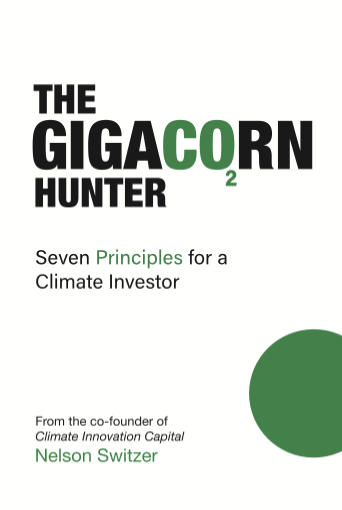
Books by Nelson Switzer, removing a billion tons of carbon from the economy
Book Nelson Switzer, removing a billion tons of carbon from the economy for your Event!